
Avian Neuroscience: Carrion Crows Execute Primate-Level Decisions in Half the Time
New research demonstrates that birds without a neocortex use identical mathematical logic to primates but process visual evidence twice as quickly.
By Chloe Kapoor ·
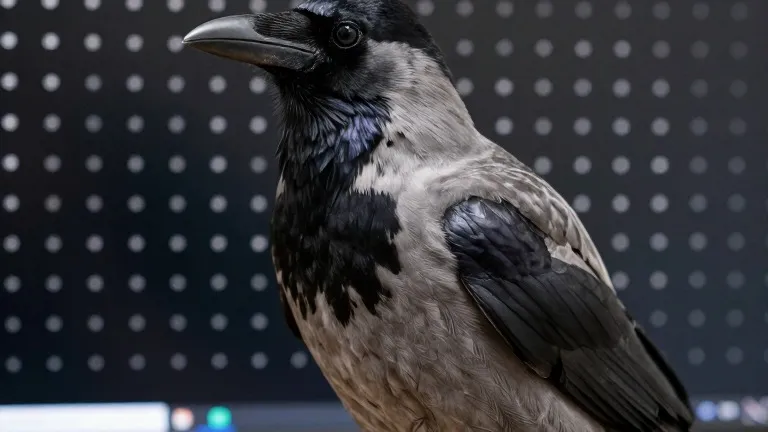
Carrion crows solve complex visual puzzles using the same logic as primates, but they finish the work twice as fast. A new study from the University of Tübingen reveals that birds can process visual evidence and commit to choices at double the speed of monkeys, despite lacking the brain structure typically associated with such cognitive tasks.
The core of the scientific debate centers on the neocortex. In primates, neurons in this region collect visual evidence over time. Their firing rates rise until they cross a threshold, triggering a decision. Because birds do not have a neocortex, scientists remained uncertain how their brains encoded similar judgments. Andreas Nieder, a neurobiologist at the University of Tübingen, identified this structural gap as the central mystery. He asked how a differently organized avian brain could encode decisions at all.
Nieder and colleague Philipp Schmidbauer designed an experiment to answer that question. They tested two hand-raised carrion crows using the random-dot-motion task. This standard test involves a cloud of flickering specks that drifts weakly in one direction. The subject must determine the direction of movement. The crows sat before a touch-sensitive monitor displaying white dots on a black background. They indicated their choice by pecking one of the targets flanking the display. A correct answer earned the bird a mealworm.
The researchers kept the setup identical to the monkey version to ensure comparability. Nieder noted that the only difference was the method of reporting. Monkeys indicated decisions through eye movements, while the crows used pecks. The team varied the difficulty by changing the fraction of dots moving coherently. At the easy end, 81 percent of the dots moved together, a simple signal to read. At the hardest end, only 3 percent moved coherently, making the signal barely distinguishable from noise. The team also included a zero percent condition with no correct answer.
The results confirmed that the crows solved the task using the same mathematical logic as primates. The birds reached their decision thresholds using comparable processes. However, the crows did so at twice the speed of the monkeys. This finding indicates that a brain without a neocortex can arrive at decisions through a comparable process. The data suggests that different brain architectures can converge on the same efficient solution for processing visual evidence.
The study provides a concrete benchmark for avian cognition. It shows that the absence of a specific brain structure does not limit the speed or accuracy of decision-making in this context. The crows matched primate performance in logic and outperformed them in speed. This challenges assumptions about the relationship between brain structure and cognitive processing rates in non-primate species.
Source: Ars Technica