1,100 Pounds of Moon Cargo Survives JPL Stress Tests
Voyager Technologies' Griffin-1 lander has finished environmental testing at NASA's Jet Propulsion Laboratory, validating its readiness to transport heavy payloads to the moon's south pole.
By Joseph Jenkins ·
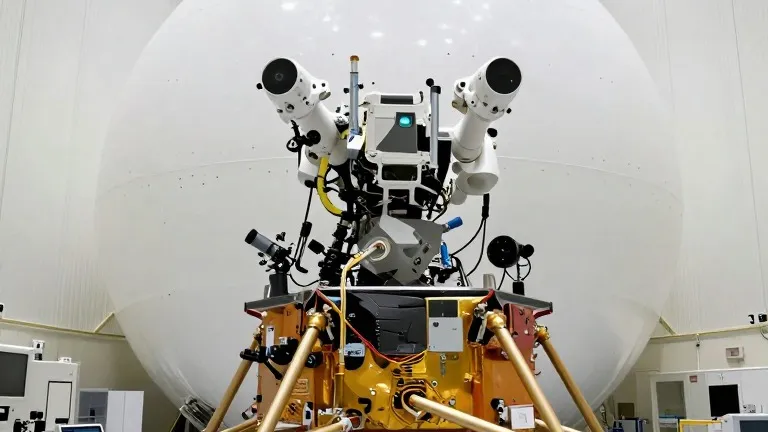
Voyager Technologies completed a comprehensive environmental test series for its Griffin-1 lunar lander at NASA's Jet Propulsion Laboratory in Southern California. The spacecraft successfully withstood the rigorous conditions required for its upcoming launch later this year. The tests were conducted in JPL's 25-foot-wide space simulator, where engineers subjected the vehicle to extreme temperature fluctuations, intense mechanical vibration, and high-intensity acoustic noise. These trials replicated the physical stresses the lander will endure during its journey from Earth to the lunar surface.
The Griffin-1 vehicle is designed to transport more than 1,100 pounds, or 455 kilograms, of cargo to a specific landing site near the lunar south pole. This mission operates under NASA's Commercial Lunar Payload Services initiative, which contracts private companies to deliver scientific instruments to the moon. The payload includes various technology demonstrations and science experiments intended for surface deployment. One key component is the FLIP rover, manufactured by Astrolab, which will traverse the terrain while carrying a specialized supercomputer.
JPL's Exploration Systems Development Office oversees the testing facilities where Griffin-1 underwent its final checks. Charles Whetsel, the office manager, noted that the laboratory has supported robotic explorers since the Ranger program in the mid-1960s. That earlier effort provided NASA with its first close-up imagery of the moon's surface. Whetsel stated that the laboratory is proud to apply its expertise to this new phase of commercial lunar exploration.
The successful completion of these ground tests marks a critical step in the mission timeline. The lander is now prepared for its flight to the moon, where it will deploy its cargo. This commercial delivery supports NASA's strategic objective of establishing a crewed presence near the lunar south pole. The agency aims to build a permanent base in that region within the next five years, relying on such cargo missions to establish initial infrastructure and test essential technologies.
Source: Space.com
More Business · Tech news · Buyer Beware · Report a business · Got a Story?