North Korea tests 700km missile as drone output scales
Moscow shares missile data for labor and weapons, driving a new era of mass-produced North Korean attack drones.
By Chloe Kapoor ·
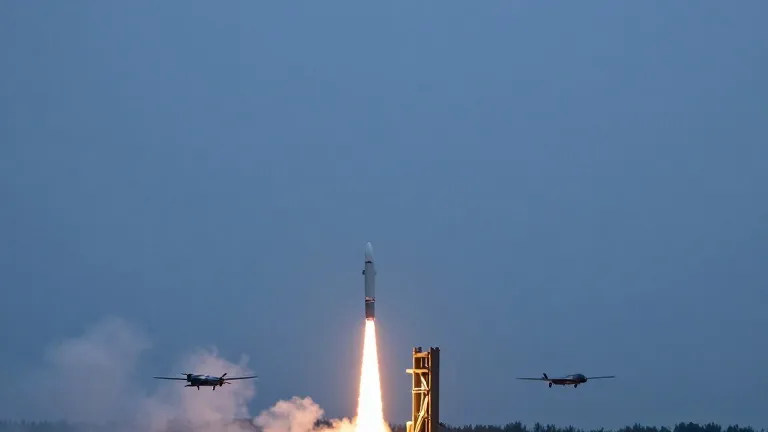
North Korea tested a tactical ballistic missile in early October that South Korea and Japan estimate flew 700 kilometers. The Democratic People's Republic of Korea claimed the weapon reached a range of 1,000 kilometers and stated it can carry a nuclear payload. This launch marked a visible escalation in Pyongyang's military capabilities, occurring as the country began mass-producing attack drones.
The expansion of North Korea's drone manufacturing is driven by a deepening partnership with Russia. The New York Times reported that Moscow is transferring military technology to Pyongyang in exchange for soldiers, workers, and weapons. Analyst Anton Ponomarenko said access to Russian deployment data and feedback has improved the accuracy and maneuverability of North Korean weapons. He described the threat to South Korea as more substantial as a result of this data exchange.
Pyongyang has studied drone warfare in Ukraine and the Middle East, noting that inexpensive aircraft can overwhelm expensive air defense systems. In a drill last month, North Korean forces simulated an attack where a drone swarm targeted an island while cruise and ballistic missiles struck from different directions simultaneously. This combined approach suggests a shift toward saturation tactics that rely on volume rather than just precision.
South Korea responded to the North's missile test with its own first hypersonic ballistic missile launch five days later. President Lee Jae Myung observed the test, a move the New York Times characterized as a sign of growing unease in Seoul over the rapid progress of North Korean missile technology. Seoul typically responds to such provocations with short public statements, but this direct military reply signaled a change in posture.
The alliance has expanded beyond data sharing to include large-scale labor exchanges. Bloomberg reported in September that up to 25,000 North Koreans are working at Russian military plants, including facilities in Alabuga, Tatarstan, to produce drones. Additionally, a North Korean missile unit capable of fielding 120 ballistic missiles and six launchers has begun deploying in western Russia. This unit is positioned for potential strikes against Ukraine.
Russia requested KN-30 ballistic missiles from North Korea in August. In June, Pyongyang announced tests of a modernized 240mm multiple-launch rocket system, a tactical ballistic missile, and a 155mm long-range artillery shell. These recent developments follow a June 2026 announcement of further artillery and missile tests, indicating a sustained pace of weapons modernization across multiple categories.
Source: Ukrainska Pravda