
Moon water reserves limit sustainable settlements to 10,000 people
New research indicates that lunar water stores are too small to support million-person cities for long, forcing a reconsideration of ambitious space colonization timelines.
By Elizabeth Morales ·
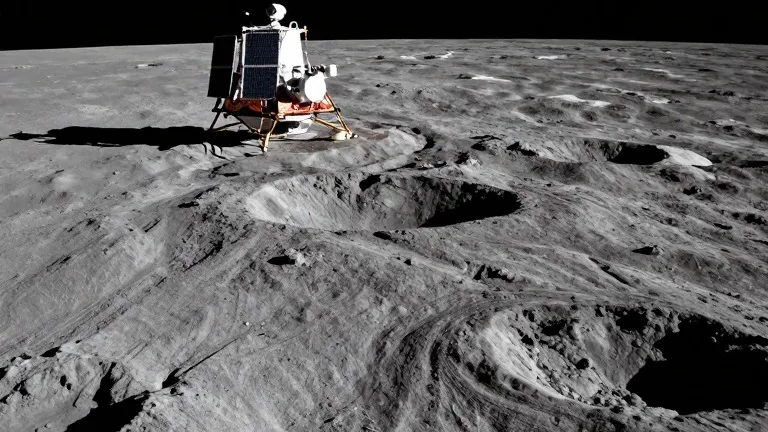
A new study published in Frontiers in Space Technologies suggests that the moon’s water supply can sustainably support a population of only 10,000 people. The analysis by Harvard astrophysicist Martin Elvis and Durham University professor Jonathan McDowell challenges recent claims by major space executives that large lunar cities are imminent.
The paper addresses two critical resources for human habitation: power and water. The researchers determined that solar and nuclear energy sources are sufficient to power a population of one million. However, water availability creates a strict ceiling on settlement size. Current estimates suggest the moon holds approximately one billion tonnes of water, mostly in permanently shadowed polar regions.
If a million people lived on the moon, those reserves would last only about 100 years. This calculation assumes a 98 percent water recycling rate, matching the efficiency currently achieved on the International Space Station. Elvis compared the total volume of lunar water to a small lake, noting that such a resource is insufficient for a large city over long periods.
The study indicates that a settlement of 10,000 residents could remain sustainable for centuries under the same assumptions. McDowell stated that covering the moon with cities, as depicted in science fiction, requires a method to transport water to the surface because it is not currently accessible in the needed quantities. He emphasized that the findings are factual rather than discouraging, stating that truth is never negative and that attempting impossible projects is the real issue.
The authors noted that their baseline assumption of one billion tonnes may be optimistic. Elvis estimated that the actual recoverable amount could be as low as one percent of that figure. If only one percent is usable, the 100-year lifespan for a million-person city shrinks to roughly one year. Gordon Osinski, a planetary geology professor at Western University, added that satellite measurements contain uncertainties and that the water may exist in a form similar to Arctic permafrost, making extraction difficult.
Source: CBC News