Canadian Metals Face EU Carbon Levy With No Exemption
Federal documents reveal that $2.8 billion in annual exports will pay a border charge starting in 2027, with Newfoundland and Quebec bearing the highest costs.
By Chloe Kapoor ·
Canada will pay a new carbon border charge on exports to the European Union, according to internal federal documents. A Global Affairs Canada memo signed on December 10, 2025, confirms that Canadian iron, steel, and aluminum products will not receive an exemption. The government describes the mechanism as a border charge or effectively a carbon tariff. This decision stands despite Canada having its own national carbon price and a trade agreement with the EU.
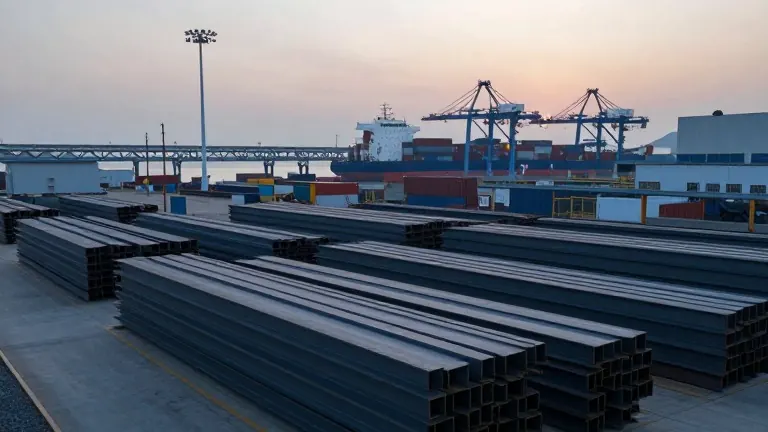
The financial exposure is substantial. Global Affairs estimates that $2.8 billion in goods face the levy each year. These are mostly metals already hit by United States tariffs. The memo notes that impacts vary by region, but two provinces face the heaviest burden. Newfoundland and Labrador has $885 million in exposed iron and steel exports annually. That figure represents almost half of the province's total. Quebec faces $792 million in exposed aluminum, iron, and steel exports. These numbers average data from 2021 to 2024.
Negotiations are underway in Montreal during the current Canada-EU Summit. Prime Minister Mark Carney stated on Tuesday that the summit begins talks for Canada to become a closer strategic partner to the 27-member bloc. Environment and Climate Change Minister Julie Dabrusin is attending the meetings. Her office says Canada is pushing for recognition of its industrial carbon pricing systems to reduce administrative burdens. Dabrusin did not confirm progress in an interview on October 22. EU officials said both sides are working toward similar baselines and processes, though details remain vague.
The lack of an exemption stems from a pricing gap. The EU carbon price is approximately $134 per tonne in 2025. Canada's price is $95 per tonne. The EU exempts countries like Switzerland, Norway, and Iceland because their pricing systems link to the EU Emissions Trading System. Canada's system is not linked. A recent energy accord with Alberta further weakened Canada's carbon price. It is unclear how the EU will credit Canada's existing price.
Industry experts warn of rising compliance costs. Ross-Linden Fraser, acting director at the Canadian Climate Institute, called the change a big deal conceptually. The mechanism will ramp up fully by 2034. Aaron Cosbey, an economist at the International Institute for Sustainable Development, noted that exporters must already measure embedded emissions and have them verified. He estimates that by 2034, Canadian steel could cost an additional $150 per tonne. That increase represents more than 10 percent of the open market price.
Some companies see a competitive edge. Mark Selby, CEO of Canada Nickel, said his company's project in Timmins, Ontario, uses low-carbon electricity and carbon capture. He argued that shipping millions of tonnes of steel to Europe would translate into pennies per tonne over the long run. Rio Tinto and ArcelorMittal declined to comment. The memo also notes that the United Kingdom, Australia, Japan, and Turkey are developing similar mechanisms, a trend it calls CBAM proliferation.
Source: CBC News
More Business · World news · Buyer Beware · Report a business · Got a Story?